
Trump weighs deploying up to 10,000 more troops to Middle East during war with Iran: report
The Pentagon is considering sending up to 10,000 additional U.S. troops to the Middle East during Operation Epic Fury, a senior defense official said, according to The Wall Street Journal.
Coverage for this event has ended.
12 US troops wounded in Iranian attack on Saudi base
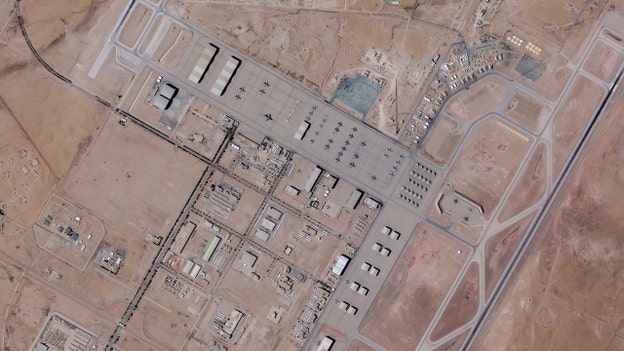
Twelve U.S. service members were wounded in an Iranian missile and drone attack on a military base in Saudi Arabia, Fox News has confirmed.
The strike hit Prince Sultan Air Base on Friday, damaging several U.S. refueling aircraft, officials said. Two of the wounded troops were reported to be in serious condition.
At least one KC-135 air refueling aircraft was hit and caught fire during the strike, according to a senior U.S. official.
The attack comes as the monthlong conflict between the U.S., Israel and Iran continues to escalate and follows earlier reports that more than 300 U.S. service members have been wounded since the start of Operation Epic Fury.
The Pentagon is continuing to move additional forces into the region, while officials say military options remain on the table as the situation evolves.
Fox News' Jennifer Griffin contributed to this reporting.
Strikes completed on Iranian regime infrastructure in three areas, IDF says
The Israeli Defense Forces said on Saturday more than 50 Israeli Air Force fighter jets participated in strikes on Iranian regime infrastructure across three areas in Iran.
The strikes hit a facility used to produce various weapons, a site used to develop and produce advanced explosive devices, and a site used to produce components for ballistic missiles and anti-aircraft missiles, among other areas, according to the IDF.
"The strikes on these sites and facilities constitute a combined degradation to the regime’s production capabilities, both in its ballistic missile program and its nuclear weapons program," the force said. "The IDF continues to operate against the regime’s military industries in order to degrade the production capabilities it has built over many years."
Abu Dhabi intercepts missile, debris sparks fires and injures multiple
Abu Dhabi authorities responded to two fires early Saturday that they said were caused by falling debris after intercepting a ballistic missile, leaving multiple people injured.
The debris fell in the Khalifa Economic Zones Abu Dhabi area, the Abu Dhabi Media Office said.
Five people sustained minor to moderate injuries, officials said.
Watchdog blasts BBC, CNN, NYT over ‘war crime’ label bias
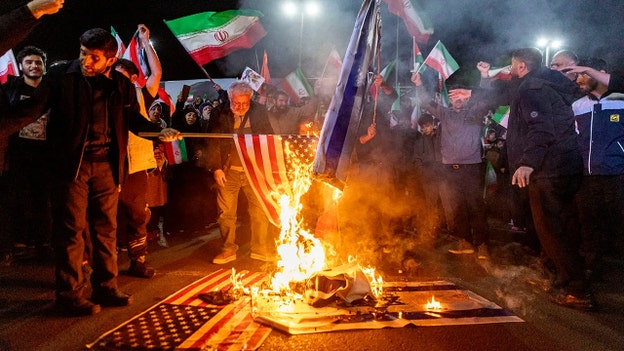
Mainstream media outlets reportedly used the phrase "war crime" nearly three dozen times in the first three weeks of the Iran conflict, but 88% of that usage was directed toward the U.S. or Israel, according to an analysis released by a U.S.-based, Mideast-focused media watchdog.
CAMERA, the Committee for Accuracy in Middle East Reporting and Analysis, and its research manager, David Litman, released a study Wednesday counting 32 uses of the term "war crime" from the BBC, CNN, NBC News, The New York Times and The Washington Post.
In his review, Litman asked readers to consider how the term "war crime" has been applied in reporting on the conflict, noting that simple internet searches return usages "almost exclusively" against the U.S. and Israel.
"CAMERA found 32 total applications of the phrase ‘war crime’ during the first three weeks of the war (Feb. 28-Mar. 21). Of those, 28 (88 percent) were directed solely toward the actions of the United States and/or Israel," Litman wrote on CAMERA’s website.
"Zero were directed solely toward the actions of the Islamic Republic of Iran. Four (12 percent) were unattributed or directed at both sides."
CAMERA found nearly all references stemmed from an airstrike early in the conflict that allegedly destroyed a school in Minab, Iran. The Pentagon is continuing to investigate the incident, according to CAMERA.
Fox News Digital reached out to communications officials at CNN, the BBC, The Washington Post, The New York Times and NBC News for comment.
This is an excerpt of an article by Fox News Digital's Charles Creitz.
Missile launched from Yemen toward Israel, IDF says, marking first since war began
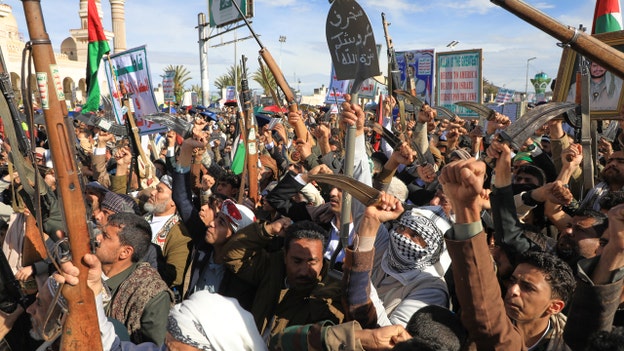
The Israel Defense Forces said early Saturday it identified a missile launch from Yemen, marking the first such launch since the war with Iran erupted.
The Israeli military said its defense systems intercepted the threat.
The launch comes after Houthi forces warned Friday they could enter the conflict if the Red Sea is used for attacks on Iran, Fox News chief national security correspondent Jennifer Griffin reported.
Trump touts progress in Iran talks and success in Venezuela, says 'Cuba is next'
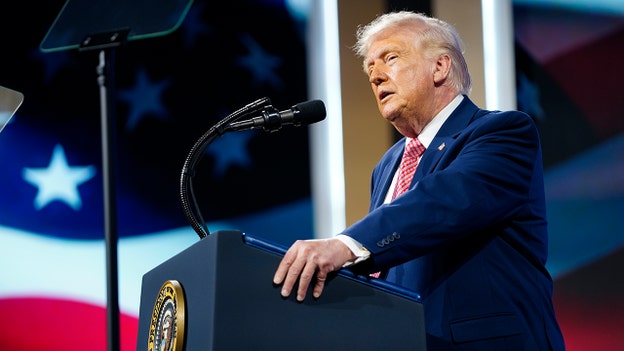
President Donald Trump on Friday signaled a shift away from the war with Iran after apparent positive negotiations this week and the administration's capture of Venezuelan leader Nicolás Maduro, saying "Cuba is next."
While speaking in Florida at the Future Investment Initiative (FII) Institute Summit at the Faena Forum in Miami Beach, Trump said even though he campaigned on peace through strength, sometimes force is necessary.
"And Cuba is next, by the way. But pretend I didn't say that," Trump said. "Please, please, please media, please disregard that statement. Thank you very much — Cuba's next."
He added that he thought NATO's absence in negotiations with Iran was a "tremendous mistake."
"They just weren't there," he said. "It's going to make a lot of money for the United States because we spent hundreds of billions of dollars a year on NATO, hundreds of protecting them. And we would have always been there for them. But now, based on their actions, I guess we don't have to be, do we?"
This is an excerpt of an article by Fox News Digital's Alexandra Koch.
Trump says US economy will ‘take off like a rocket ship’ after Iran war ends
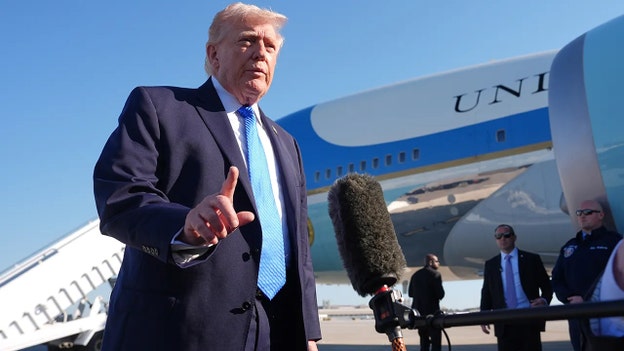
President Donald Trump on Friday predicted the U.S. economy would surge once the war with Iran ends.
“When this war ends, it's going to be like a rocket ship,” Trump said during a speech at the FII Priority Summit, adding that “we won't have that dark cloud hanging over our head.”
The president said the economy would benefit from Iran no longer pursuing nuclear weapons.
Trump also said he expected oil prices to rise and stocks to fall further during the ongoing conflict, adding, “It hasn't been that bad.”
State Department reveals world's most dangerous countries for Americans
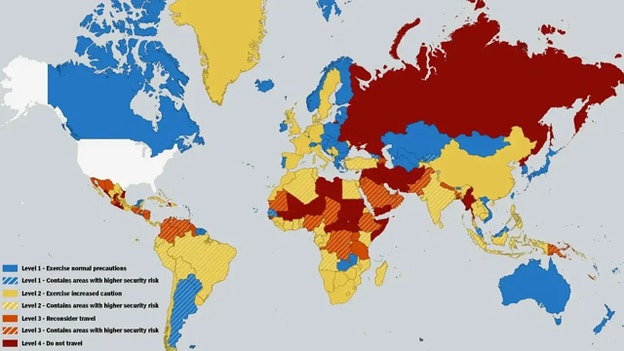
The State Department has continued to update its travel advisories as the conflict with Iran and adversarial relationships with other nations continue to play out across the world.
Americans traveling abroad could be targets for arbitrary arrests or attacks, the agency has warned.
In its interactive world map, the agency has branded several Middle Eastern countries as unsafe for Americans to travel to. Saudi Arabia, Oman, Kuwait and Bahrain have moved from Level 2 to Level 3 advisories, meaning Americans should exercise caution or reconsider their travels to those locations altogether, the New York Post first reported.
Iran has been branded a "Level 4: Do Not Travel" destination, with Americans facing risks of wrongful detention, violence and kidnapping amid the unrest there.
Last week, the State Department issued a worldwide security alert warning Americans to be cautious about threats from groups linked to Iran.
"From now on, based on the information we have about you, even parks, recreational areas and tourist destinations anywhere in the world will no longer be safe for you," Iranian Brigadier General Abolfazl Shekarchi warned Americans and Israelis on Iranian state television.
Countries with a Level 4 warning ("Do Not Travel") include Afghanistan, Haiti, Iraq, Libya, Russia, Somalia, Sudan, Ukraine and Yemen.
The U.S. may not have a consular presence in those nations, and U.S. citizens there could have difficulty accessing services. Russia, in particular, has been known to wrongfully detain Americans for years.
Countries with a Level 3 advisory — meaning Americans should reconsider travel — include Bahrain, Colombia, Honduras, Israel, Nicaragua, Qatar, Saudi Arabia, the United Arab Emirates and Venezuela.
Countries where Americans should exercise increased caution (Level 2) include Cuba, the Dominican Republic, France, Greenland, Italy, Mexico and the United Kingdom.
Parts of Mexico have been designated as Level 4 zones, including Sinaloa and Colima, while other states like Jalisco and Baja California are designated Level 3 due to cartel activity.
This is an excerpt of an article by Fox News Digital's Louis Casiano.
Houthis threaten to widen war as US considers major troop surge
Houthi forces warned they could enter the conflict if the Red Sea is used for attacks on Iran, raising concerns about a broader regional war, Fox News chief national security correspondent Jennifer Griffin reported Friday on 'Special Report.'
The warning comes as the U.S. weighs deploying up to 10,000 additional troops to the Middle East, a move that could take at least two weeks, according to officials.
The forces could be used to seize territory, secure airfields or assist in efforts to reopen the Strait of Hormuz, a mission current and former military commanders say carries significant risk.
More than 40,000 U.S. service members are already stationed at bases in the region that have come under repeated missile and drone attacks, forcing some personnel to relocate to civilian housing.
While U.S. forces have destroyed 92% of Iran’s large naval vessels, officials warn smaller, agile boats capable of laying mines and launching attacks still pose a serious threat to ships passing through the strategic waterway.
Fox News' Jennifer Griffin contributed to this reporting.
Russia, Iran reportedly discuss potential diplomatic end to war
Russia’s foreign minister discussed the possibility of a diplomatic settlement in the Iran war with his Iranian counterpart on Friday, according to Reuters.
Russian Foreign Minister Sergei Lavrov and Iran’s Abbas Araqchi held talks on shifting the conflict toward a “political-diplomatic settlement” based on international law, Russia’s foreign ministry said.
The discussion comes as fighting continues across the region and amid growing international pressure to de-escalate the conflict.
Reuters also reported that Western officials have accused Moscow of supporting Tehran militarily, including providing satellite imagery and assisting with drone upgrades.
Russia and Iran maintain a strategic partnership but without a formal mutual defense pact.
Trump urges Saudi Arabia to join Abraham Accords as Iran war ‘transforms’ region
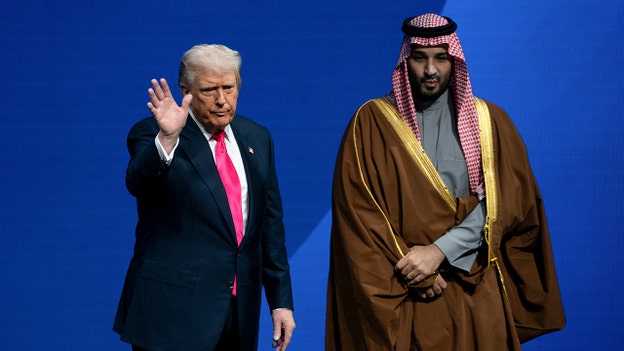
President Donald Trump is urging Saudi Arabia to join the Abraham Accords, arguing the war with Iran is reshaping the Middle East and creating a new opportunity for regional normalization.
Speaking at a conference in Miami, Trump said the region is being “transformed” by the conflict and “the future… has never been brighter,” according to the Times of Israel.
“I hope you’re going to be getting into the Abraham Accords finally,” Trump said, calling on Saudi officials to move forward with joining the agreement.
Trump suggested Iran’s weakening position has removed a key obstacle to normalization, saying, “It’s now time… we’ve now taken them out.”
He also referenced past conversations with Saudi Crown Prince Mohammed bin Salman, describing repeated delays in Riyadh’s decision to join the accords.
The Abraham Accords, first brokered during Trump’s previous administration, normalized relations between Israel and several Arab nations, though Saudi Arabia has yet to formally join.
Israel says most Iranian missile launchers destroyed as tunnel hunt intensifies: report
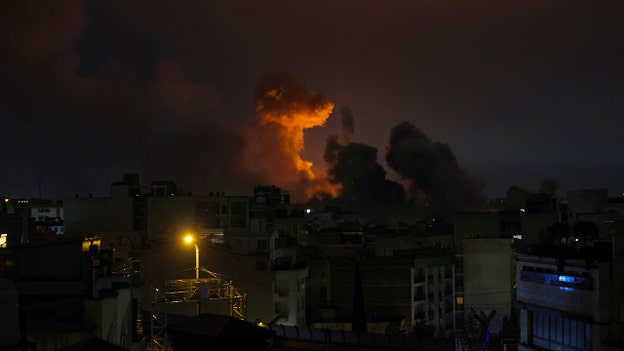
Israel has destroyed or severely damaged the majority of Iran’s missile launchers as it intensifies strikes on underground tunnel systems, according to a report in the Jerusalem Post.
Of roughly 470 launchers, fewer than 180 — about 40% — remain operational, while the rest have been taken out or disabled in airstrikes, the report said.
Israeli officials say Iran’s ability to fire missiles has been degraded, with the regime struggling to meet its earlier goal of launching 100 missiles per day due to coordination issues and a shrinking number of working launchers.
The report also cited growing difficulties among Iranian forces operating the systems, including signs of dissent among launch crews.
Israeli operations have focused on locating launchers hidden in extensive tunnel networks, using precision strikes to target sites buried underground, though officials say the terrain continues to complicate detection and response efforts.
The campaign is part of Israel’s broader push to dismantle Iran’s missile capabilities under Operation Roaring Lion.
US eyes seizing Iran’s oil lifeline — but it may not cripple Tehran
U.S. officials and analysts are weighing whether seizing Iran’s main oil export hub could deal a crippling financial blow — but experts warn the high-risk move may not shut off Tehran’s revenue as quickly or completely as expected.
Analysts say U.S. planners face a high-stakes decision: whether seizing Kharg Island would actually disrupt Iran’s oil revenue or leave key export flows intact while exposing American forces to sustained attack. Options under discussion range from interdicting tankers at sea to striking export infrastructure from the air, approaches some argue could pressure Tehran’s finances without putting troops on the ground.
"There’s a big debate going on right now," R.P. Newman, Marine veteran and counterterrorism analyst, told Fox News Digital.
Kharg Island handles the vast majority of Iran’s crude oil exports, making it one of the most strategically significant energy nodes in the region and a central pressure point for any effort to economically squeeze Tehran.
"We certainly have the ability, military wise, to take it," said R.P. Newman, a Marine veteran and counter-terrorism analyst.
Some analysts argue that taking Kharg could deliver an immediate economic shock, cutting off the regime’s primary source of oil revenue and potentially giving Washington leverage in broader negotiations.
But such an operation would not be simple.
"It would take thousands to do that," he said.
U.S. forces already have struck the island hitting more than 90 Iranian military targets, including missile and naval mine facilities, earlier in March while deliberately avoiding oil infrastructure, leaving export operations largely intact.
Retired Adm. Kevin Donegan, former commander of the U.S. Navy’s 5th Fleet, said the same objective could be achieved without putting U.S. forces on the island.
"You could achieve that desired outcome just by constraining the flow that comes out of Kharg after it gets outside the Gulf," Donegan said.
"You could stop every ship that comes out," he added.
Robbins said the U.S. could also disable Kharg’s export capability with air power rather than seizing it outright.
An influx of thousands of troops from Marine expeditionary units and the Army's 82nd airborne division has raised speculation that a ground operation could be on the way.
But Secretary of State Marco Rubio said Friday U.S. operations could wrap in "weeks, not months" and without ground troops.
"We are ahead of schedule on most of (the objectives), and we can achieve them without any ground troops, without any," Rubio told reporters during a trip to Paris for a meeting of G-7 foreign ministers.
This is an excerpt of an article by Fox News Digital's Morgan Phillips.
Trump says US ‘crushing’ Iran as region nears freedom from regime, teases new name for Hormuz Strait
President Donald Trump said Friday the Middle East is “closer than ever” to being free from Iran as U.S. operations against the regime intensify.
Speaking in Miami, Trump said the U.S. is “decimating Iran’s capabilities” through Operation Epic Fury and moving toward ending what he described as years of “terror, aggression and nuclear blackmail.”
“We’re closer than ever to the rise of the Middle East that is finally free at last from Iranian terror,” Trump said.
He also claimed Iran is seeking negotiations amid continued strikes.
“They’re being hit so hard… they’re begging to make a deal,” Trump said.
Trump added that any agreement would require Iran to reopen the Strait of Hormuz, briefly jokingly referring to it as the “Strait of Trump” before correcting himself.
Russia reportedly sending upgraded drones to Iran amid war
Russia is sending upgraded drones to Iran, including advanced versions of designs originally supplied by Tehran during the war in Ukraine, U.S. and European officials told The Associated Press.
The drones include improvements developed by Russia on the battlefield, such as enhanced navigation systems and anti-jamming capabilities, according to the report.
Officials said it is unclear how many drones are being transferred or whether the shipment is part of a broader series, but intelligence suggests discussions between Moscow and Tehran have intensified in recent weeks.
The move comes as Iran continues launching drone attacks across the Middle East following U.S. and Israeli strikes, raising concerns that more advanced systems could make interception more difficult.
Secretary of State Marco Rubio said Friday that Russian support for Iran has not impacted U.S. operations, despite the growing cooperation between the two countries.
US, Iraq move to keep country out of Iran war, boost counterterror cooperation
The United States and Iraq have agreed to step up security coordination while working to keep Iraq out of the expanding war with Iran.
In a statement shared on X, the U.S. Embassy in Baghdad said both sides established a High Joint Coordination Committee and agreed to intensify efforts to prevent terrorist attacks and ensure Iraqi territory is not used as a launch point for attacks against Iraq, U.S. personnel or neighboring countries.
Officials emphasized their shared goal of keeping Iraq “outside the scope of the ongoing military conflict in the region,” while respecting the country’s sovereignty.
The two sides also reaffirmed their commitment to counterterrorism cooperation, with an emphasis on Iraqi-led efforts to maintain stability and protect key infrastructure.
The move comes as tensions escalate across the Middle East, raising concerns about the conflict spilling into additional countries.
US using armed drone boats to patrol Middle East waters in Iran war
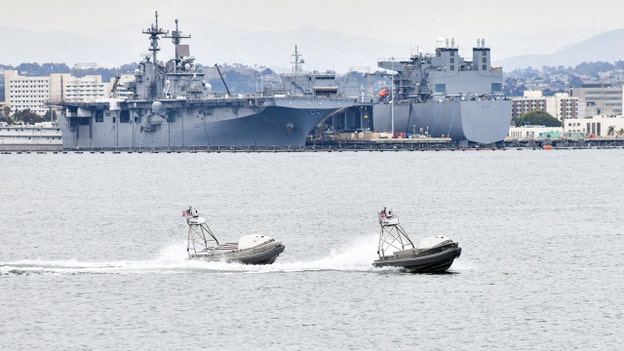
The U.S. Navy is deploying unmanned boats capable of surveillance and potential strikes as part of operations in the Middle East, according to a Reuters report cited by Stars and Stripes.
The vessels, known as Global Autonomous Reconnaissance Craft (GARC), have logged more than 450 hours at sea and traveled over 2,200 nautical miles during patrols, a U.S. Central Command (CENTCOM) spokesperson said.
The high-speed drone boats can carry payloads of up to 1,000 pounds and are designed for missions ranging from intelligence gathering to mine detection and targeting support.
Their deployment comes as the U.S. looks for ways to secure key waterways, including the Strait of Hormuz, where Iran has targeted ships with missiles and drones.
It is not clear whether the unmanned vessels have been used in direct strikes, but officials say they are part of a broader push to expand drone warfare capabilities in the region.
Iran backlash forces Gulf allies toward Washington as regional tensions rise
Saudi Arabia and other Gulf allies are showing signs of a quiet but consequential shift in their posture toward Iran, as escalating attacks across the region are testing years of careful balancing between Washington and Tehran.
For much of the past decade, countries like Saudi Arabia and the United Arab Emirates (UAE) sought to avoid direct confrontation with Iran, maintaining diplomatic and economic ties even while relying on U.S. military backing. But that middle ground is increasingly under strain.
That strategy was designed to keep Gulf states out of direct confrontation. But officials and analysts say Iran’s expanding attacks are narrowing the space for neutrality, pushing some Gulf states closer to Washington.
One of the clearest signs of that shift is a reported move by Saudi Arabia to grant U.S. forces access to King Fahd Air Base in Taif, a western facility not used for American combat operations since the Gulf War era.
The shift is also visible across the region. The UAE has severed diplomatic ties with Tehran, shut down Iranian-linked institutions and launched a crackdown on networks tied to the Islamic Revolutionary Guard Corps after a wave of attacks.
Bahrain, meanwhile, led efforts at the United Nations to pass a Security Council resolution condemning Iranian strikes on Gulf states, while multiple countries — including Saudi Arabia, the UAE, Qatar and Kuwait — have issued coordinated statements denouncing Iran’s actions and asserting their right to self-defense.
These Gulf states are in line with the U.S. view that Iran's missile development, uranium enrichment programs and support for regional militant groups need to be "addressed and curtailed" but remain opposed to strikes on critical infrastructure inside Iran, a Gulf official told Fox News Digital.
Qatar has also taken concrete steps in response to Iranian attacks, expelling Iranian military and security attachés and ordering them to leave the country after strikes on critical energy infrastructure. However, Qatar has stopped short of severing full diplomatic ties, maintaining its role as a mediator even as tensions rise.
The Qatari prime minister was in Washington for talks focused on defense cooperation and protecting critical energy infrastructure Thursday, an official briefed on the visit told Fox News.
King Fahd Air Base's location, deep inside Saudi territory and farther from Iran’s missile and drone reach, would offer strategic depth the U.S. has not relied on in decades. U.S. military posture in the region has long centered on more exposed bases along the Persian Gulf, including hubs in Qatar and the United Arab Emirates.
Sources familiar with the matter cited in Wall Street Journal reporting said Saudi Arabia agreed to let American forces use the base. The Pentagon and the Saudi embassy declined to comment on the base. Combat aircraft routinely operate "dark" with transponders off in potential combat zones, so they would not appear on civilian flight radar.
Saudi Arabia's tightly controlled media environment also means there are few, if any, independent local reports of U.S. aircraft activity at King Fahd Air Base.
"Our primary concern today is to defend ourselves from the daily attacks on our people and our civilian infrastructure," the Saudi government said in a statement on its posture toward Iran. "Iran has chosen dangerous brinkmanship over serious diplomatic solutions. This harms every stakeholder involved but none more than Iran itself."
This is an excerpt of an article by Fox News Digital's Morgan Phillips.
US can only confirm about one-third of Iran’s missiles destroyed: report
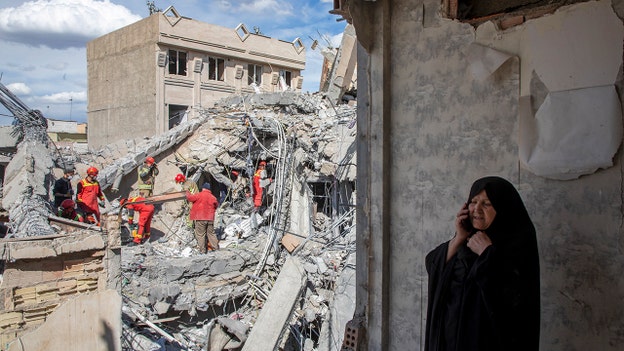
The U.S. can only confirm it has destroyed about one-third of Iran’s missile arsenal, according to sources familiar with U.S. intelligence cited by Reuters and reported by the Jerusalem Post.
Officials say another third of the missiles may have been damaged, destroyed or buried in underground tunnels, but their status remains unclear. Iran is believed to still retain a significant number of operational missiles.
The assessment comes as the U.S.-Israel campaign nears the one-month mark and highlights the difficulty of tracking weapons stored in hardened bunkers and tunnel networks.
It also contrasts with President Donald Trump’s recent claim that Iran has “very few rockets left,” even as Tehran continues launching missiles and drones across the region.
Ukraine, Saudi Arabia strike defense pact as Zelenskyy warns of Iran-linked attacks
Ukrainian President Volodymyr Zelenskyy announced a new defense cooperation agreement with Mohammed bin Salman, saying the deal will expand technological collaboration and strengthen joint security efforts.
Zelenskyy said the arrangement between Ukraine’s and Saudi Arabia’s defense ministries “lays the foundation for future contracts, technological cooperation, and investment.”
He also linked Ukraine’s battlefield experience to current tensions in the Middle East, noting Ukrainians have faced “the same kind of terrorist attacks — ballistic missiles and drones — that the Iranian regime is currently carrying out” across the region.
The Ukrainian leader said Kyiv is prepared to share its defense expertise while also benefiting from Saudi capabilities, calling the partnership “mutually beneficial.”
Zelenskyy added that discussions with Saudi leadership also covered broader regional developments, including the war involving Iran, energy markets and Russia’s ties to Tehran.
303 US troops wounded in Iran operation, most injuries tied to brain trauma: CENTCOM
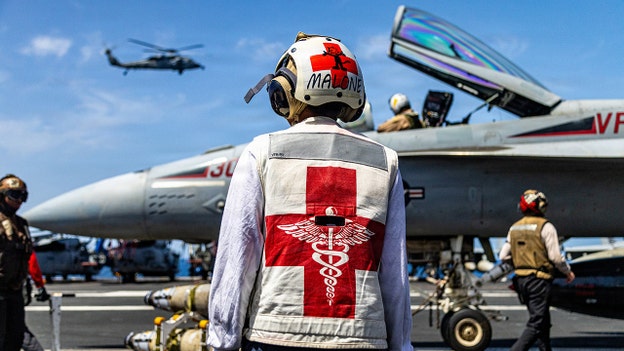
A total of 303 U.S. service members have been wounded since the start of Operation Epic Fury, U.S. Central Command (CENTCOM) said.
More than 75% of those injuries are tied to traumatic brain injuries (TBI), CENTCOM spokesperson Navy Capt. Tim Hawkins told Fox News.
Officials said the TBIs range from mild concussions that can sideline troops for a short period to symptoms that may not appear for several days, making them more difficult to track.
The update comes as U.S. forces continue operations across the Middle East amid ongoing strikes against Iranian targets and retaliatory attacks in the region.
Fox News' Liz Friden contributed to this reporting.
Rubio says Iran war could end in ‘weeks, not months’ as US avoids ground troops
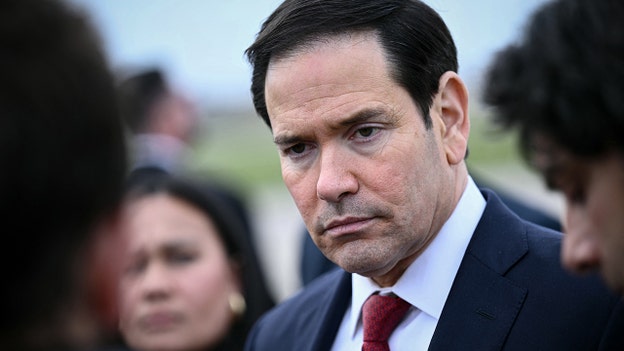
Secretary of State Marco Rubio said Friday the U.S. expects its war against Iran to conclude in a matter of “weeks, not months,” arguing American forces are already ahead of schedule in achieving key objectives.
Speaking to reporters after meetings with G7 foreign ministers in France, Rubio said the U.S. has made significant progress in degrading Iran’s military capabilities, including its missile and drone programs, as well as its navy and air force, according to Reuters.
“We are ahead of schedule on most of them, and we can achieve them without any ground troops,” Rubio said.
His comments come as the Pentagon weighs additional troop deployments to the region, including up to 10,000 more forces, though Rubio said those moves are intended to give President Donald Trump flexibility if conditions change, Reuters reported.
“The president has to be prepared for multiple contingencies,” Rubio said.
Israel’s military strikes Arak heavy water plant, a key Iranian site for nuclear weapons production
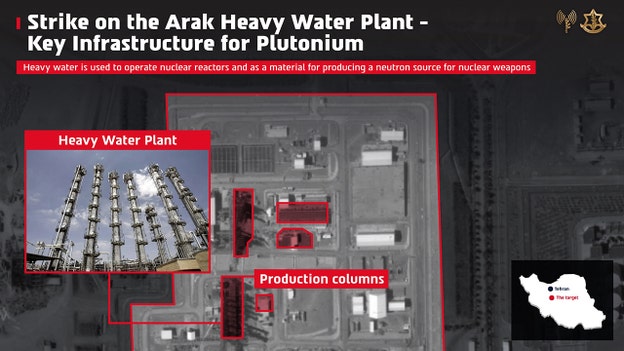
The Israeli Air Force launched targeted strikes Friday against a heavy water plant in central Iran described by Israel’s military as a “key plutonium production site for nuclear weapons” for the regime.
“A short while ago, the Israeli Air Force, acting on IDF intelligence, struck the heavy water plant in Arak, central Iran,” the IDF said, noting that reconstruction activity was observed at the site.
“Heavy water is a unique material used to operate nuclear reactors, such as the inactive Arak reactor, which was originally designed to have weapons-grade plutonium production capabilities. These materials can also be used as a neutron source for nuclear weapons,” it said.
The IDF also said the plant was a significant economic asset for Iran’s terror regime and "served as a source of income for the Iranian Atomic Energy Organization, generating tens of millions of dollars for the regime each year.”
Israel said the plant was previously hit during Operation Rising Lion in June 2025, and “since then, repeated reconstruction attempts by the Iranian terror regime have been identified.”
“Therefore, the IDF has now struck the facility once again,” the IDF added.
Israel also said Friday that it hit a uranium extraction plant in Yazd, Iran.
“This plant is the only one of its kind in Iran, where raw materials mined from the earth undergo mechanical and chemical processing so that they can later be used as raw materials for uranium enrichment,” according to the IDF.
G7 meets on Iran, says there is ‘no justification for the deliberate targeting of civilians’
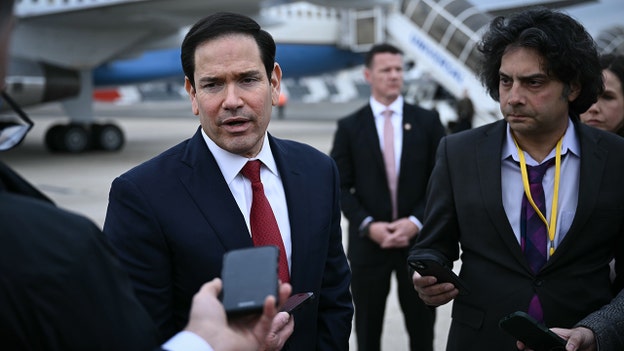
A statement released by G7 foreign ministers Friday following a meeting in France said there is “no justification for the deliberate targeting of civilians in situations of armed conflict as well as attacks on diplomatic facilities.”
“We, the G7 Foreign Ministers of Canada, France, Germany, Italy, Japan, the United Kingdom, and the United States of America, and the High Representative of the European Union, met under France’s G7 Presidency, at Abbaye des Vaux-de-Cernay, France from March 26 to 27, 2026,” the statement read. “We discussed the situation in Iran and the region."
“We underscored the importance of minimizing the impact of the conflict on regional partners and civilian populations, critical infrastructure -- and the need to coordinate humanitarian aid efforts,” the statement continued. “We call upon an immediate cessation of attacks against civilians and civilian infrastructure. There can be no justification for the deliberate targeting of civilians in situations of armed conflict as well as attacks on diplomatic facilities.”
The Iranian regime has been launching attacks on its neighbors in the Middle East for weeks now following the launch of the joint U.S.-Israel military campaign.
Israel says it found Hezbollah weapons inside of a school in Lebanon
The Israel Defense Forces said Friday that it uncovered “anti-tank rockets, mortar shells, grenades, launchers, light firearms, explosives and more” belonging to Hezbollah inside a school in southern Lebanon.
The reported discovery was made in the area of Al-Khiyam, where the IDF earlier said its soldiers discovered “active Hezbollah terrorist infrastructure within the vicinity of a church”
“All of this was found alongside UNHCR [United Nations High Commissioner for Refugees] markings of the United Nations,” the IDF added.
The terrorist group Hezbollah has coordinated with Iran in attacks against Israel since the beginning of Operation Epic Fury and Operation Roaring Lion on Feb. 28.
Iran backlash forces Gulf allies toward Washington as regional tensions rise
Saudi Arabia and other Gulf allies are showing signs of a quiet but consequential shift in their posture toward Iran, as escalating attacks across the region test years of careful balancing between Washington and Tehran.
For much of the past decade, countries like Saudi Arabia and the United Arab Emirates sought to avoid direct confrontation with Iran, maintaining diplomatic and economic ties even while relying on U.S. security guarantees. But that middle ground is increasingly under strain.
That strategy was designed to keep Gulf states out of direct confrontation. But officials and analysts say Iran’s expanding attacks are narrowing the space for neutrality, pushing some Gulf states closer to Washington.
One of the clearest signs of that shift is a reported move by Saudi Arabia to grant U.S. forces access to King Fahd Air Base in Taif, a western facility not used for American combat operations since the Gulf War era.
The shift is also visible across the region. The United Arab Emirates (UAE) has severed diplomatic ties with Tehran, shut down Iranian-linked institutions and launched a crackdown on networks tied to the Islamic Revolutionary Guard Corps following a wave of attacks.
FBI says Iran-based hackers targeted Kash Patel's personal email, no government information involved
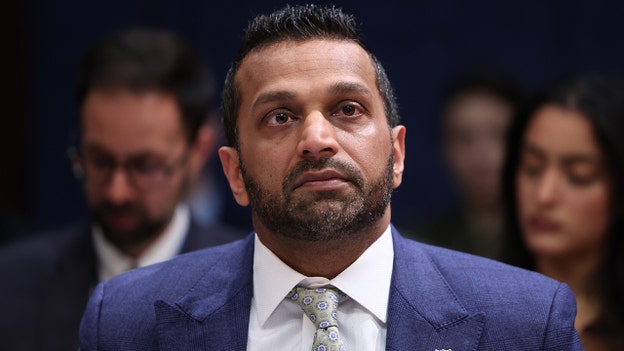
The FBI said Friday that "malicious actors" targeted Director Kash Patel's personal email, as an Iran-based hacking group claimed responsibility. The State Department is offering a reward of up to $10 million for information leading to the identification of the Handala Hack team in Iran.
"The FBI is aware of malicious actors targeting Director Patel’s personal email information, and we have taken all necessary steps to mitigate potential risks associated with this activity," an FBI spokesperson said in a statement to Fox News. "The information in question is historical in nature and involves no government information."
"The Department of State's Rewards for Justice program offers up to a $10 million reward for information leading to the identification of the Handala Hack Team out of Iran – a group that has frequently targeted U.S. government officials. Consistent with President Trump's Cyber Strategy for America, the FBI will continue to pursue the actors responsible, support victims, and share actionable intelligence in defense of networks," the statement added. "We encourage anyone who experiences a cyber breach, or has information related to malicious cyber activity, to contact their local FBI field office.”
The FBI noted that no government information was impacted and the investigation is ongoing. The Handala Hack Team is claiming responsibility.
This comes after the Department of Justice just seized domains part of the group's operation on March 19 during "an ongoing effort to disrupt hacking and transnational repression schemes conducted by the Islamic Republic of Iran’s Ministry of Intelligence and Security (MOIS)."
The DOJ said seized domains "were used by the MOIS in furtherance of attempted psychological operations targeting adversaries of the regime by claiming credit for hacking activity, posting sensitive data stolen during such hacks, and calling for the killing of journalists, regime dissidents, and Israeli persons.
Fox News' David Spunt and Jake Gibson contributed to this report.
Around 303 US service members wounded since Operation Epic Fury began: CENTCOM spox
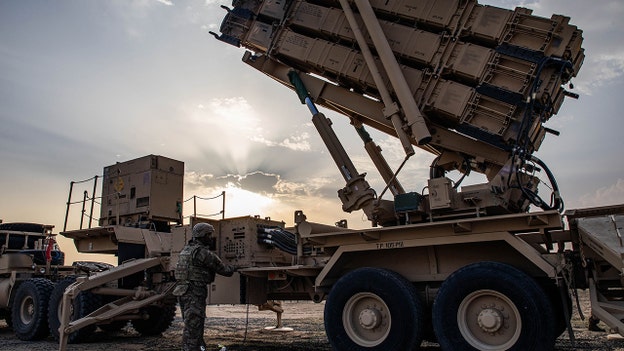
A total of 303 American troops have been wounded during Operation Epic Fury against Iran.
"The vast majority of these injuries have been minor, and 273 troops have returned to duty," Capt. Tim Hawkins, spokesman for U.S. Central Command, told Fox News on Friday.
Earlier in the week, Hawkins said 290 U.S. service members were injured.
The U.S. military operation, which was launched Feb. 28, also has resulted in the deaths of 13 American service members.
Six service members were killed in a March 1 Iranian drone attack in Kuwait, while another service member died of injuries suffered during an Iranian attack on troops in Saudi Arabia on the same day.
On March 12, another six service members were killed when a KC-135 refueling aircraft crashed in western Iraq during a combat mission in support of Operation Epic Fury.
Fox News' Liz Friden contributed to this report.
Kuwait port comes under 'attack by hostile drones'
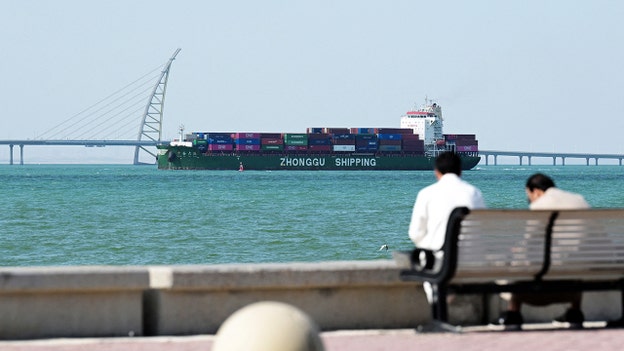
The Kuwait Ports Authority said Friday that its Shuwaikh Port "was subjected to an attack by hostile drones with no human casualties."
The agency describes the port as Kuwait's "main commercial port," located in the Shuwaikh Industrial Area outside of Kuwait City.
The port "serves as a vital hub for storing and distributing goods, as well as accommodating commercial ships, making it a cornerstone of the country’s maritime trade," the Kuwait Ports Authority added.
Iran has been targeting its neighbors across the Middle East and threatening maritime travel in the Persian Gulf during Operation Epic Fury.
IDF uncovers ‘active Hezbollah terrorist infrastructure within the vicinity of a church’
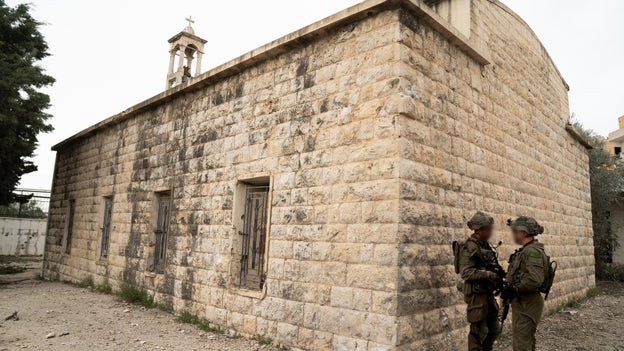
The Israel Defense Forces said its soldiers discovered “active Hezbollah terrorist infrastructure within the vicinity of a church” in southern Lebanon.
During searches in the area of Al-Khiyam, the troops “exposed and located a tunnel shaft and an underground infrastructure constructed within the church vicinity.”
“This combat zone, which the Hezbollah terrorist organization used for military activity, was first located by IDF troops in December 2024 and was then cleared of weapons and terrorists,” the IDF said. “During the current searches in the vicinity, the soldiers located three additional shafts constructed by Hezbollah during the ceasefire, indicating renewed use of the site.”
“The repeated use of this site demonstrates Hezbollah’s systematic modus operandi of exploiting Lebanese civilians as human shields and deliberately embedding military infrastructure within religious sites and civilian areas,” it added.
Fox News’ Yael Rotem-Kuriel contributed to this report.
UAE intercepts another 6 ballistic missiles, 9 UAVs from Iran
The United Arab Emirates said its air defense systems intercepted on Friday “6 ballistic missiles and 9 UAVs launched from Iran.”
“Since the start of the blatant Iranian attacks, UAE air defenses have engaged 378 ballistic missiles, 15 cruise missiles and 1,835 UAVs,” the country’s Ministry of Defense wrote on X.
“The Ministry of Defense affirmed that it remains fully prepared and ready to deal with any threats and will firmly confront anything that aims to undermine the security of the country, in a manner that ensures the protection of its sovereignty, security and stability and safeguards its interests and national capabilities,” it also said.
The UAE is one of several countries in the Middle East that has had to repel attacks from Iran following the launch of the joint U.S.-Israel military campaign on Feb. 28.
CENTCOM releases new video of US strikes against Iranian infrastructure
U.S. Central Command released a new video Friday showing a wave of American strikes on Iran, saying "U.S. forces continue to eliminate the Iranian regime’s ability to project military power beyond its borders."
CENTCOM said Thursday that American forces have hit more than 10,000 targets since the beginning of Operation Epic Fury on Feb. 28.
The military campaign is on its 28th day as of Friday.
“Since the commencement of Operation Epic Fury, 92% of the large ships in the Iranian Navy have been eliminated,” CENTCOM Commander Adm. Brad Cooper added.
Israel’s strikes against Iran are set to ‘move up a level,’ defense minister says
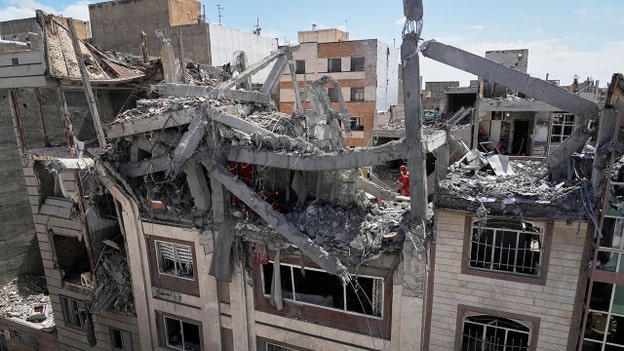
Israel’s Defense Minister Israel Katz warned the regime in Tehran Friday that “IDF strikes in Iran will move up a level and expand to additional targets.”
He said Israel Defense Forces “activity in Iran against security and military targets continues without pause.”
“We will continue to hunt the leaders and commanders of the terror regime and destroy its strategic capabilities,” Katz added. “Prime Minister Benjamin Netanyahu and I warned the Iranian terror regime to stop the missile fire toward the civilian population in Israel.”
“Despite the warnings, the fire continues — and therefore, IDF strikes in Iran will move up a level and expand to additional targets and areas that assist the regime in the construction and operation of weaponry against the citizens of Israel,” he also said. “They will pay heavy and increasing prices for this war crime.”
Fox News’ Yael Rotem-Kuriel contributed to this report.
Rubio meets G7 ministers in France as US leads on Iran — allies under fire for tepid response
Secretary of State Marco Rubio arrived in France on Friday to attend the G7 foreign ministers' meeting where he will deliver a clear message on U.S. priorities for the ongoing war with Iran.
In the days leading up to the meeting, other members have taken markedly different approaches to the war. Nearly all of Washington’s partners — Britain, Canada, France, Germany, Italy and Japan — have reacted cautiously to the U.S.-Israeli military campaign and declined to participate in offensive operations, even as they condemn Iranian actions.
Before departing on Thursday, Rubio signaled a defiant approach to the talks: "I don’t work for France or Germany or Japan … the people I’m interested in making happy are the people of the United States. I work for them," he said in a video posted on X.
The divergence has drawn frustration from President Donald Trump, who has pressed allies to contribute more, particularly in securing key maritime routes such as the Strait of Hormuz. While some countries have signaled a willingness to support defensive or maritime security efforts, they have stopped short of joining direct military strikes.
"The U.S. is constantly asked to help in wars, and we have. But when we had a need, it didn’t get positive responses from NATO. A couple leaders said that Iran was not Europe’s war. Well, Ukraine isn’t our war, yet we’ve contributed more to that fight than anyone," Rubio added.
"The Strait of Hormuz could be open tomorrow if Iran stops threatening global shipping, which is an outrage and a violation of international law. For all these countries that care about international law, they should be doing something about it," he said before boarding his plane to France.
Qatar confirms meetings with Vice President JD Vance, Treasury Secretary Scott Bessent
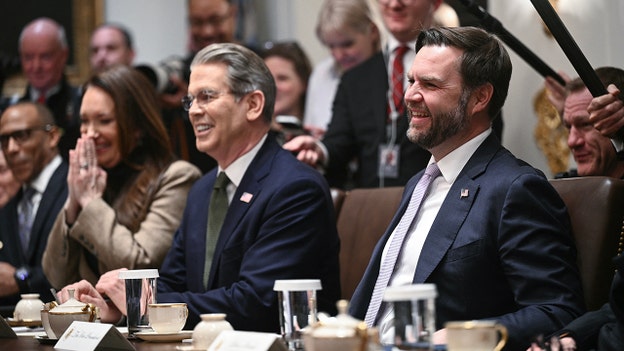
The Qatari prime minister and foreign affairs minister met in Washington, D.C., with Vice President JD Vance and Treasury Secretary Scott Bessent, the Middle Eastern nation confirmed Friday.
Prime Minister and Minister of Foreign Affairs Sheikh Mohammed bin Abdulrahman bin Jassim Al-Thani discussed "the close strategic cooperation between the State of Qatar and the United States and explored ways to further strengthen it across various fields, particularly in the area of defense partnership in light of current regional developments, in a manner that serves the shared interests of the two countries," according to the state-run Qatar News Agency (QNA).
Since Operation Epic Fury began, Iran has launched missile and drone attacks impacting Qatar as part of the regime's broader retaliation against the U.S. and allied actions in the conflict.
The Qatar News Agency (QNA) said "discussions also covered developments in global energy markets, with both sides underscoring the importance of ensuring the sustainability of energy supplies and maintaining the continued flow of liquefied natural gas from the State of Qatar to global markets, thereby supporting global energy security."
“For his part, the U.S. Vice President praised the robust strategic partnership between the two countries, hailing the State of Qatar's active role in promoting regional stability and enhancing global energy security,” it added.
Cruz says Trump's move to strike Iran 'most consequential decision' of his presidency
Republican Sen. Ted Cruz says that the U.S. is "unquestionably winning the war" with Iran.
And the conservative firebrand and three-term senator from Texas tells Fox News Digital that, in his opinion, President Donald Trump's "decision to launch this military action is the most consequential decision" of his presidency.
"If you look at how our military has carried out this action, it has been an incredible success," Cruz emphasized in an interview this week.
But many Americans don't agree with the senator's reading on the nearly month-long strikes by the U.S. and Israel on Iran.
Several new national surveys released this week, including a new Fox News poll, indicate that most Americans give the military strikes a thumbs down. But the surveys point to a continued broad partisan divide between Democrats and Republicans over the ongoing fighting in the volatile Middle East.
The military attacks by the U.S. and Israel have resulted in the deaths of Iranian Supreme Leader Ayatollah Ali Khamenei and other top officials, and the decimation of the country's military.
Israeli military strikes 'heart of Tehran' as Trump extends Strait of Hormuz deadline
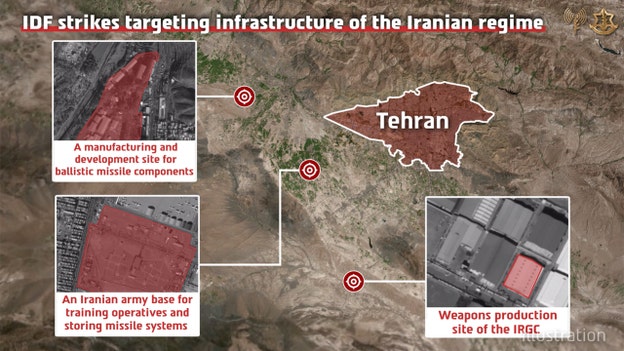
The Israeli military reportedly said Friday that it completed a wide scale wave of strikes overnight "in the heart of Iran."
The Israel Defense Forces (IDF) said it struck dozens of military industries, launch sites and operatives from the missile array in Tehran.
Acting on IDF intelligence, the Israeli Air Force "completed a wide-scale wave of strikes targeting infrastructure belonging to the Iranian terror regime," the IDF said. It added that the strikes "further degraded production capabilities and struck dozens of weapons production sites."
Among the sites targeted were “a base used by the Iranian army to train operatives and store missile systems intended to target aircraft,” "a site for the manufacturing and development of ballistic missile components,” "a site for manufacturing batteries for weapons," and a "weapons production site" of the Islamic Revolutionary Guard Corps, the IDF said.
“Overnight, a staging and launch complex of the Islamic Revolutionary Guard Corps was struck, along with ballistic missile launch sites, air defense systems, and observation posts belonging to both the IRGC and the Iranian military,” according to the IDF. “In addition, the IDF identified several operatives from the ballistic missile array operating from a military structure in Tehran. Minutes after the identification, the Israeli Air Force struck and eliminated the terrorists who were planning to advance launches against the State of Israel.”
The IDF also said in a post on X Friday that it hit the "Iranian Regime’s primary facility for the productions of missiles and sea mines in Yazd, Iran."
"The site was used for the planning, development, assembly, and storage of advanced missiles intended for launch from cruise platforms, submarines, and helicopters toward both mobile and stationary maritime targets," it said.
On Thursday, President Donald Trump confirmed he was placing a hold on strikes against Iran’s energy sector for another 10 days, until April 6. The pause is intended to allow time for ceasefire negotiations to take place.
Fox News’ Emma Bussey, Yael Rotem-Kuriel and The Associated Press contributed to this report.
Trump weighs deploying 10,000 extra troops to Middle East, defense official says
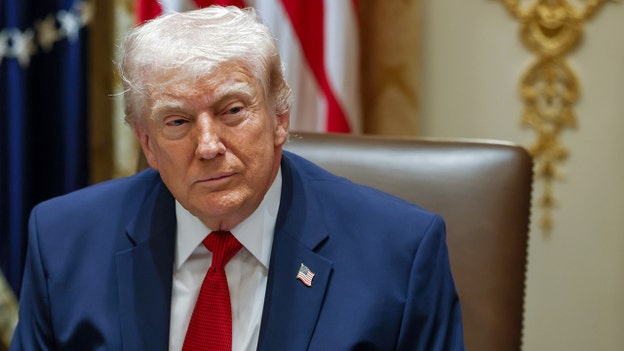
The Pentagon is considering sending up to 10,000 additional ground troops to the Middle East, a senior defense official said Thursday, according to the Wall Street Journal.
While the official said it was not yet clear which units would be mobilized, the new deployment would be in addition to the 1,500 troops deployed from the 82nd Airborne.
Earlier Thursday, President Donald Trump confirmed he was placing a hold on strikes against Iran’s energy sector for another 10 days, until April 6. The pause is intended to allow time for ceasefire negotiations to take place.
Pakistan is reportedly mediating the talks between the two nations.
Live Coverage begins here